
Wellbeing at St Mary's
Over the course of their education, children spend over 7,800 hours at school. With such a huge amount of time spent in the classroom, schools provide an ideal environment for promoting good emotional wellbeing and identifying early behaviour changes and signs of mental distress. The social and emotional skills, knowledge and behaviours that young people learn in the classroom can help them to build resilience and set the pattern for how they will manage their mental health throughout their lives. Emotional wellbeing is a clear indicator of academic achievement, success and satisfaction in later life. Evidence shows that mental health and wellbeing programmes in schools, can lead to significant improvements in children’s mental health, and social and emotional skills. Wellbeing provision in schools can also lead to reductions in classroom misbehaviour and bullying.
Please use this link to view our Wellbeing Policy.
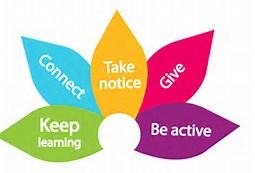
Five Ways to Wellbeing
Connect: Spend time with family and friends. Enjoy doing things together and talking to each other.
Be active: It keeps you physically healthy, and makes you feel good
Keep learning: Try something new. Try a new hobby, or learn about something just because it interests you.
Take notice: Take a break to see how you feel. Relax and look around you or listen to music, take a few deep breaths.
Give: Do something for a friend or relation/adult, as well as making them feel good, it can make you feel good too!

Step 1 - Connect
Connecting with others can help us feel close to people, and valued for who we are. Being social means different things for different people – you might prefer being in quieter situations with one other person, or you might like being in big groups. You might like to connect with people online, or you might enjoy phone calls or sending letters.
Here are some ways you could make a connection today:
- If you feel comfortable, you could try speaking to someone new
- Ask how someone’s weekend was, and really listen when they tell you
- Put 5 minutes aside to find out how a colleague is doing
- Give a colleague a lift to work or share the journey home with them
Step 2 - Get Active
Many people find that physical activity helps them maintain positive mental health.
This doesn't have to mean running marathons or training every day at the gym. There are lots of different things you can do to be a bit more active.
Studies have shown that getting active can help you sleep better, have happier moods, and reduce feelings of stress, anxiety and racing thoughts.
Here are a few ideas for how you can get active today:
- Take the stairs rather than the lift
- Go for a walk at lunchtime
- Walk into work – maybe you could go with a colleague
- Get off the bus a stop earlier than usual and walk the final part of your journey to work
- Organise a work sporting activity
- Have a kick-about in a local park
- Do some stretches before you leave for work in the morning
- If you're in the office, walk over to someone’s desk instead of calling or emailing
Step 3 - Take Notice
Reminding yourself to take notice can help you to be aware of how you're feeling. It can help you understand what triggers your feelings of stress or anxiety.
Some studies have shown that savouring ‘the moment’ can also help you to feel more positive about life.
Take some time to enjoy the moment and the environment around you. Here are a few ideas:
- Get a plant for your workspace
- Have a ‘clear the clutter’ day
- Take a different route on your journey to or from work
- Visit a new place for lunch
Step 4 - Learn
We're always learning new things – often without realising it. Feeling like you're learning and developing can boost your self-esteem.
And sometimes, setting goals can help you to feel more productive and more in control of your life.
What can you learn today? Here are a few ideas:
- Find out something about your colleagues
- Sign up for a class
- Read the news or a book
- Set up a book club
- Do a crossword or Sudoku
- Research something you’ve always wondered about
- Learn a new word
Step 5 - Give
There's been lots of research about the effects of taking part in social and community life. Some studies have shown that people who help others are more likely to rate themselves as happy.
Is there anything you can do today, to be kind or helpful to someone else? You could try:
- Making a cup of tea for a colleague
- Offering to help a colleague with something they're stuck on
- Introducing yourself to a new-starter, to help them feel more at ease
- Seeing if there are any volunteering initiatives open at work

Can We Help...Mental Health and Wellbeing
Please select the document below.

|
We Can Help - Mental Health and Wellbeing | [pdf 1MB] |

|
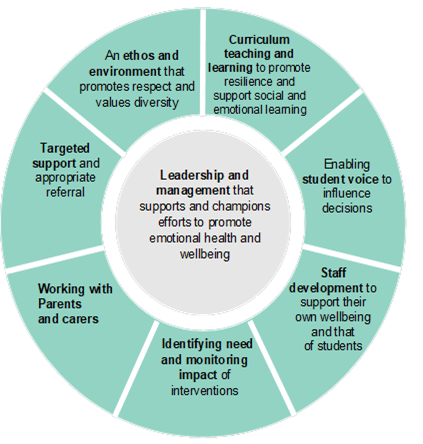
Eight principles to promoting a whole school approach to mental health and wellbeing
The eight principles to promoting a whole school and college approach to mental health and wellbeing is presented in a wheel diagram with ‘leadership and management that support and champions efforts to promote emotional health and wellbeing’ at the centre. Radially surrounding this core principle are the 7 other principles below, arranged in a clockwise manner:
• Curriculum teaching and learning to promote resilience and support social and emotional learning
• Enabling student voice to influence decisions
• Staff development to support their own wellbeing and that of students
• Identifying need and monitoring impact of interventions
• Working with parents and carers
• Targeted support and appropriate referral
• An ethos and environment that promotes respect and values diversity
|
|
Promoting children and young people's mental health and wellbeing | [pdf 982KB] |
|
Leadership and Management
To implement an effective whole school approach, incorporating the 8 principles requires coordinated change within a setting, and a collective and individual responsibility to promoting and supporting mental health and wellbeing that involves all staff. A senior leadership team that champions efforts to promote mental health and wellbeing is essential to ensure changes are accepted and embedded. Having a governor with knowledge and understanding of mental health and wellbeing issues is also highly desirable in championing organisation wide practices.
Senior Mental Health Lead - Mrs S. Hall
The strategic lead for implementing the whole school approach to mental health and wellbeing within school.
Ethos and Environment
The physical, social and emotional environment in which staff, pupils and students spend a high proportion of every weekday has been shown to affect their physical, emotional and mental health and wellbeing as well as impacting on their attainment and behaviour.
The DfE Respectful School Communities tool supports schools to develop a whole school approach that promotes a culture of respect, and the tool sets out what is needed to achieve this. Guidance also recognises the importance of an individualised response to pupil or student needs, when behaviour might be a result of educational, mental health, other needs, or vulnerabilities, such as special educational needs and disabilities. Taking a traumainformed approach can help contribute towards creating a safe environment for those who have experienced trauma and adverse experiences. Relationships between staff and pupils, and between students, are critical in promoting wellbeing and in helping to engender a sense of belonging to and liking of school. The special educational needs and disability (SEND) code of practice provides statutory guidance and practical advice education settings on how to carry out the duty to provide for those with special educational needs.
Curriculum, Teaching and Learning
School based programmes of social and emotional learning have the potential to help young people acquire the skills they need to make good academic progress as well as benefit pupil health and wellbeing.
As part of the Health Education curriculum, all pupils will be taught about mental health. By the end of primary school, pupils are expected to be able to recognise what is normal and what is an issue in themselves and others and, when issues arise, know how to seek support as early as possible from appropriate sources. By the end of secondary school, students should understand how they are feeling and why; to further develop the language that they use to talk about their bodies, health and emotions; and to understand where normal variations in emotions end, and health and wellbeing issues begin. Other parts of the wider curriculum can complement PSHE or RSE and Health Education such as lessons in physical education, the arts and citizenship, and tutorials.
Student Voice
Involving students in decisions that impact on them can benefit their mental health and wellbeing by helping them to feel part of the school, college and wider community and to have some control over their lives. At an individual level, benefits include helping students to gain belief in their own capabilities, including building their knowledge and skills to make healthy choices and developing their independence. Collectively, students benefit through having opportunities to influence decisions, to express their views and to develop strong social networks.
Staff Development, Health and Wellbeing
Promoting staff health and wellbeing is an integral principal of the whole school approach to mental health and wellbeing. Teaching and learning establishments can go some way in demonstrating a commitment to staff health and wellbeing in a number of ways. This can include providing opportunities for assessing the mental health and wellbeing needs of staff, by providing support to enable staff to reflect on and to take actions to enhance their own wellbeing and by promoting a work-life balance for staff.
Identifying Needs and Monitoring Impact
Identifying pupil and student need on a more formal basis can help to inform commissioning decisions at school level. It can also assist in recording and monitoring the impact of any support that is put in place.
Working with Parents, Families and Carers
The family plays a key role in influencing children and young people’s mental health and wellbeing. Schools should ensure that the mental health and wellbeing support offer is clearly communicated with parents and carers. Where schools and colleges identify additional needs, they should work closely with the local authority to ensure parents and carers are aware of the wider support available to them in their local area.
Targeted Support and Appropriate Referrals
Some children and young people are at greater risk of experiencing poorer mental health. For example, those who are in care, young carers, those who have had previous access to NHS CYPMHS, those living with parents or carers with a mental illness and those living in households experiencing domestic violence. Delays in identifying and meeting emotional wellbeing and mental health needs can have far reaching effects on all aspects of children and young people’s lives, including their chances of reaching their potential and leading happy and healthy lives as adults.
Mental Health Resources for Children, Parents, Carers and School Staff
Please click on the picture link to access the resources.

Mental Health and Wellbeing
The last year has been extra stressful, especially if you’re a parent. It's normal and entirely understandable if you're feeling overwhelmed frustrated, worried or exhausted about the situation.
You might be finding it harder than ever at the moment to know how to best look after your child’s mental health and wellbeing, as well as your own. If you’re struggling, you are not alone. Here are some resources that can really help.

Oldham Council Support and Resources
The Oldham whole school and college approach to emotional health and mental wellbeing aims to promote social, emotional and mental wellbeing.
The framework offers practical guidance to schools and colleges to develop knowledge and skills to promote mental health and wellbeing and prevent minor problems from escalating into more serious long-term issues.
The document contains key actions that head teachers and college principles can take to embed the whole school approach to emotional health and mental wellbeing.
The actions are based on the eight principles.
These are:
- The school ethos and environment
- Curriculum, teaching and learning
- Student voice
- Staff development, health and wellbeing
- Identifying need and monitoring impact
- Working with parents / carers
- Targeted support
Please select from the documents below or click on the picture link to access Oldham Council Wellbeing page.
|
|
Emotional Health and Mental Wellbeing - Emotional Health and Wellbeing Services | [pdf 1MB] |
|
|
|
Supporting Young Minds Through Tough Times | [pdf 6MB] |
|
|
|
Emotional Health and Mental Wellbeing - Graduated Response | [pdf 1MB] |
|
|
|
Emotional Health and Mental Wellbeing - Self Assessment Check List | [pdf 1MB] |
|
|
|
Key Partners and Quality Assurance Booklet | [pdf 1MB] |
|